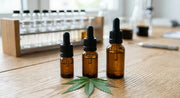
CBD is now available in many forms, and oil remains one of the best known. Yet on each of our bottles, there’s a phrase that frequently comes up in our customers’ questions: “This product is not intended for consumption.” What does this mean, where does it come from, and why is it important to heed this warning when buying CBD oil? We answer all these questions in this article.

What does the statement “not intended for food use” mean?
This statement specifies the context in which the product is sold. It indicates that the oil is not marketed as a food product and should not be used as such.
In practical terms, this is ausage instruction — —just like “keep out of reach of children” or “store away from light.” The manufacturer specifies a particular use; outside of that, the product has not been designed or evaluated for the intended use.
This applies to all of our oils, regardless of their concentration: 5%, 10%, 20%, or 30%. The percentage determines the amount of CBD in the bottle, not the instructions for use.
CBD, a “novel food” in Europe
To understand this statement, we need to take a brief look at European regulations. Regulation (EU) 2015/2283 governs“novel food” —that is, that were not consumed to a significant extent in the European Union prior to May 1997. A novel food may only be sold as such after its safety has been assessed and it has received official authorization.
Since 2019, the European Novel Food Catalog has classified CBD and hemp extracts containing cannabinoids in this category. Several applications for authorization have been submitted. In June 2022, the European Food Safety Authority (EFSA) stated that it could not yet conclude on the safety of CBD due to a lack of sufficient data, while also noting that it had not concluded that it was unsafe. An update published in February 2026 confirmed that gaps in the data persisted.
To date, no CBD extract has been authorized as a novel food. Hemp seeds and their derivatives, such as hemp seed oil, are not subject to these regulations: they have been consumed for a long time and are not covered by this framework.
What a reputable label guarantees
The label isn't just there to provide usage instructions. It's the product's ID, and it protects you. A complete label includes:
- the CBD percentage and the bottle's capacity;
- the type of extract (full-spectrum, broad-spectrum, or isolate) and the list of ingredients;
- the lot number, which is used to locate the corresponding analysis report;
- the shelf life and storage conditions;
- the contact information for the person responsible for placing the product on the market;
- the usual precautions, including the statement “not intended for food use.”
The batch number is particularly useful: it links your bottle to the laboratory tests that verify the CBD level and THC content, which is limited to 0.3% in the UK for hemp extracts and products containing them.
Why follow the label instead of advice found online?
There’s no shortage of advice online about how to use CBD oils. Some of it is outdated, some comes from countries with different regulations, and some doesn’t cite any sources at all. It’s hard to sort through it all.
The label, on the other hand, is the responsibility of the seller. It complies with French and European regulations and evolves along with them. If there’s any doubt between advice you read on a forum and what’s written on the bottle, it’salways the label that takes precedence. For more information, our guideat —questions to ask yourself before buying CBD oil —helps you evaluate a product.
Finally, CBD oil is not a medication. If you are taking any medications, are pregnant, or are breastfeeding, consult your doctor or pharmacist before using a CBD product.
Conclusion: The “for use” label—information to be taken seriously
The phrase “This product is not intended for human consumption” is not merely a formatting detail. It stems from CBD’s status as a novel food in Europe and establishes the framework within which our oils are sold. Following this guidance means using the product as intended. To compare our products with complete transparency, visit our“ ” page for affordable CBD oil at , and feel free to contact us if you have any questions about a label.